Marketing attribution from your own sales: which posts, ads and emails made the money
Hermoso now matches your Shopify orders and Stripe payments to the posts, ads and emails that led to them, with revenue per channel, campaign and post. From the app, ChatGPT or Claude.
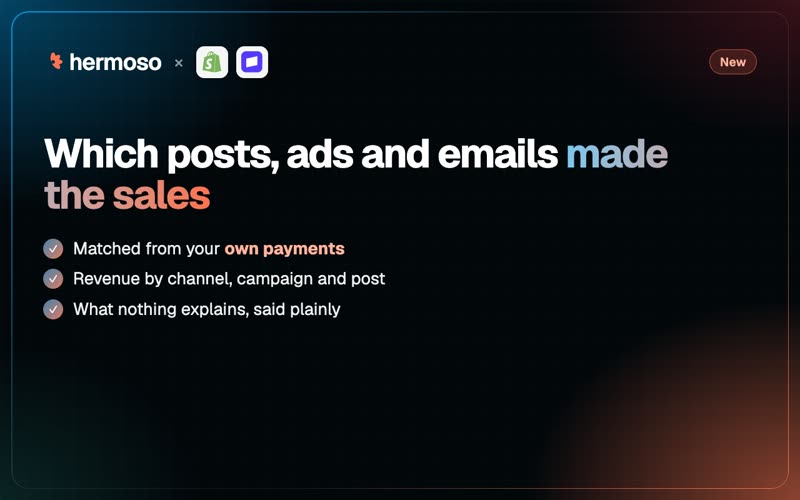
"Which of our posts actually sold anything?" is the question every small team gets asked and almost nobody can answer. The ad platforms each claim the sale. Google Analytics tells a third story. Starting today Hermoso answers it from the one source that cannot be argued with: your own payments.
How it works
Hermoso reads your Shopify orders and your Stripe payments, whichever you have connected, and matches each payment once, strongest evidence first:
- Led to the sale. A Hermoso tracking link on the buyer's visit, a Hermoso checkout, a discount code Hermoso created, or your ads' UTM tags.
- A match, not proof. The buyer was emailed by Hermoso in the days before paying (30 by default, up to 90), or arrived from a platform you post to. These are shown as matches and labelled that way.
- Unattributed. Whatever nothing explains is shown as unattributed. It is never shared out across your channels to make the totals look tidy.
Google Analytics and the ad platforms' own conversion counts appear beside the result, never added into it. Money stays in its own currency, and a source Hermoso could not read is said plainly instead of showing as zero.
What you see
Revenue, payments and customers by channel, by campaign, by single post, ad or email, or by how each match was made. So "Instagram" is not one number: you can see the Reel from 12 November that brought in four orders and the carousel that brought none.
Tracking links, if you want them
Switch on tracking links and Hermoso tags links to your own site when a post goes out, an email is sent or an ad is made. It leaves alone any link that already has UTM tags, short links, Instagram and TikTok captions and your own blog. You can also tag one link for your bio, a newsletter or a QR code. It is off until you turn it on.
A worked example
A coffee roaster posts on Instagram and LinkedIn, runs a small Meta campaign and sends a monthly email. At the end of the month they open Sales by source. Of 210 orders, 38 came through tagged links from Instagram posts, 21 used the code from the Meta ads, 17 bought within a week of the email and 134 are unattributed, mostly repeat buyers coming straight to the shop. The LinkedIn posts brought two orders. Next month they keep the email, double the Reels and stop spending time on LinkedIn.
In the app or from ChatGPT and Claude
In Hermoso, open Schedule, More, Sales by source. Or ask your agent: Which of my posts, ads and emails led to sales in the last 30 days, by post? It runs revenue_by_source; set_tracking_links turns tagging on or makes one tagged link. Reading your own accounts costs no credits.
More: connect your Shopify store, the integrations and the changelog.
Questions people ask
What is marketing attribution?
Working out which of your marketing (posts, ads, emails) led to each sale. Hermoso does it from your own Shopify orders and Stripe payments, matching each payment once to the strongest evidence it has.
Does Hermoso add Google Analytics and ad platform conversions to the total?
No. They are shown beside the result for comparison and never added in, because each of them would count some of the same sales again.
What happens to sales nothing explains?
They are shown as unattributed. Hermoso never spreads them across channels.
Do I need tracking links?
No. Discount codes, UTM tags and your email history already match many payments. Tracking links are optional and off until you switch them on, and they only tag links to your own site.
Which payment sources does it read?
Shopify orders and Stripe payments, whichever your brand has connected.